AI voice calls are rapidly reshaping how businesses talk to customers, prospects, and employees. Instead of waiting on hold or navigating clunky phone menus, people can now speak naturally with an intelligent assistant that understands their intent, responds in real time, and solves problems on the spot. Find out about AI customer support solutions that enhance service efficiency while streamlining call center processes.
Companies looking to manage AI workloads efficiently can explore advanced cloud computing services for AI applications at FlashMob Computing. To ensure reliable performance for AI voice call systems, businesses may also benefit from high-performance supercomputing solutions for real-time processing featured on Supercomputer Box.
Marketing teams aiming to maximize engagement can see practical AI-driven customer marketing strategies at Marketing for Customers or learn about innovative marketing approaches for customer retention on Marketing Runners. Finance teams optimizing budgets for AI projects should consider top financial resources for tech investment planning at Top Financial Resources.
Used well, AI voice calls do more than cut costs. They upgrade the entire experience: faster answers, less friction, and personalized interactions delivered at scale, 24 hours a day. Integrating these advanced tools across operations ensures businesses can maintain exceptional service without overloading staff.
Top AI Voice Call Solutions for Modern Contact Centers
AI voice call technology is transforming how businesses manage customer interactions. From automating routine inquiries to enabling intelligent routing and analytics, choosing the right platform is essential for efficiency and customer satisfaction. Here are the top AI-powered contact center solutions to consider.
1. Bright Pattern – Leading AI Contact Center Platform
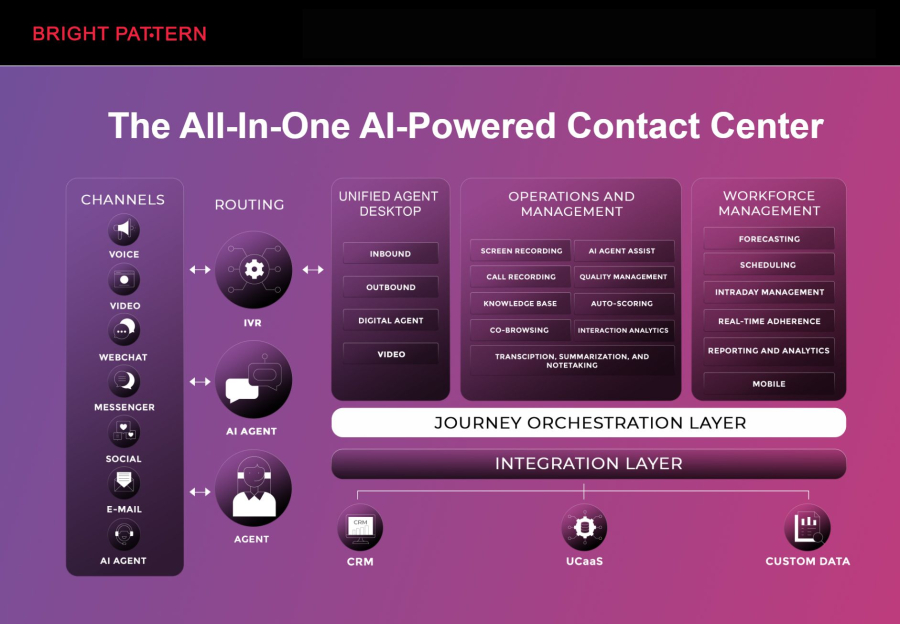
Bright Pattern is a comprehensive AI contact center solution designed to streamline customer interactions across voice, chat, and social channels. It enables businesses to provide faster, more personalized service while improving agent productivity.
Key features of Bright Pattern include:
- Intelligent call routing based on customer history and preferences
- AI-powered voice interactions that understand natural language
- Omnichannel support integrating voice calls, chat, email, and messaging apps
- Real-time analytics and performance dashboards for supervisors
- Easy integration with CRM systems and other business tools
Bright Pattern’s AI voice call capabilities allow companies to reduce wait times, automate repetitive tasks, and maintain a consistent customer experience across all channels. This makes it ideal for businesses looking to enhance both agent efficiency and customer satisfaction.
2. Five9 – Cloud Contact Center Software
Five9 offers AI-enabled call management, predictive dialing, and virtual agent support, helping organizations optimize customer interactions. It supports omnichannel engagement and provides detailed reporting for performance insights.
3. Genesys Cloud CX – AI-Powered Contact Center
Genesys Cloud CX leverages AI voice call technology to improve routing, agent assistance, and customer self-service. It integrates voice, chat, email, and social messaging for a unified customer experience.
4. NICE inContact CXone – Customer Experience Platform
NICE inContact CXone uses AI to automate interactions and provide real-time guidance to agents. It includes workforce optimization, analytics, and multi-channel routing to enhance efficiency.
5. Talkdesk – Enterprise Cloud Contact Center
Talkdesk offers AI-driven voice and chat solutions that help automate workflows, reduce agent workload, and deliver personalized customer experiences. Its virtual agent technology supports natural language processing for improved interactions.
6. RingCentral Contact Center – Omnichannel AI
RingCentral Contact Center integrates AI-powered voice call handling with CRM systems, enabling intelligent call routing, analytics, and enhanced reporting. It also provides automated workflows for routine tasks.
7. 8x8 Contact Center – Cloud-Based AI Solution
8x8 delivers AI-enabled call management, predictive analytics, and intelligent routing to optimize contact center performance. Its unified platform supports voice, chat, and social messaging.
8. Vonage Contact Center – AI Voice Solutions
Vonage provides AI-assisted voice calls, chatbots, and analytics to improve customer engagement. Its platform allows businesses to deliver personalized experiences across multiple communication channels.
9. Cisco Contact Center – AI Integration
Cisco Contact Center integrates AI voice call technology with existing enterprise systems. It supports smart routing, automated interactions, and detailed analytics to enhance agent productivity and customer satisfaction.
10. Salesforce Service Cloud Voice – AI-Powered CRM
Salesforce Service Cloud Voice combines telephony with AI capabilities, enabling real-time transcription, intelligent routing, and analytics. It supports omnichannel service for a seamless customer experience.
What Is an AI Voice Call?
AnAI voice callis a phone conversation where a software based voice assistant handles all or part of the interaction instead of a human agent. Callers speak in natural language, and the system uses artificial intelligence to understand, decide what to do, and respond with a human like voice.
Behind the scenes, an AI voice calling solution typically includes:
- Automatic speech recognitionto turn spoken words into text.
- Natural language understandingto detect intent, context, and key details like dates, amounts, or account numbers.
- Dialogue managementto decide the best next step in the conversation.
- Text to speechto convert the assistant's response into natural sounding audio.
- Integrations with business systemsso the assistant can look up information, trigger actions, or update records in real time.
The result is a voice experience that feels much closer to speaking with a helpful, well trained human than to pressing buttons in an old style phone menu.
Key Components of an AI Voice Calling System
To understand how AI voice calls create value, it helps to break the system into its core components.
1. Speech recognition
Speech recognition converts audio into text. Modern engines can handle different speaking speeds, accents, and noisy environments with impressive accuracy, especially when they are configured for specific industries or vocabularies.
2. Natural language understanding
Natural language understanding, often called NLU, determines what the caller wants. It identifies:
- The caller'sintentsuch as pay my bill, reset my password, book an appointment, or check my order status.
- Entitiessuch as dates, names, locations, product types, or amounts.
- Contextsuch as whether the caller is following up on a previous request or starting something new.
3. Dialogue management
Dialogue management decides what the assistant should do next. It keeps track of what has already been said, what information is still missing, and which business rules apply. This is what allows conversations to feel natural instead of robotic.
4. Text to speech
Text to speech, or TTS, turns the assistant's responses into spoken audio. With modern voices, you can choose tones that match your brand, from warm and friendly to professional and concise.
5. Integrations and automation
The real power of AI voice calls comes from connecting them to your existing tools. Integrations let the assistant:
- Pull data from customer relationship systems or ticketing platforms.
- Update records after each call automatically.
- Trigger workflows such as sending confirmations, creating tasks, or escalating issues.
In combination, these components turn incoming and outgoing calls into intelligent, outcome driven conversations.
Business Benefits of AI Voice Calls
When implemented thoughtfully, AI voice calls can deliver value across productivity, revenue, and customer satisfaction.
1. Always on, 24/7 availability
AI voice assistants never sleep. They can answer calls outside business hours, during peak demand, or when your human team is busy. Customers can resolve routine issues on their own, at the exact moment they need help.
2. Scalable service without proportional staffing
With traditional contact centers, handling more calls usually means hiring and training more agents. An AI voice solution can scale to handle far more volume with only incremental infrastructure costs. Human agents then focus on higher value, complex cases.
3. Faster call handling and shorter wait times
AI voice calls can identify the reason for the call within a few seconds, pull up the relevant information automatically, and guide the caller through next steps. This typically leads to shorter call durations, less time on hold, and smoother call routing.
4. Consistent, compliant conversations
Because AI voice calls run on predefined logic and approved language, they deliver consistent experiences from one call to the next. You can bake compliance, disclaimers, and best practice wording directly into the flows, reducing risk and training overhead.
5. Personalized interactions at scale
When connected to your data, AI voice calls can greet callers by name, reference recent purchases, and tailor recommendations. What once required deep familiarity from an experienced agent can now happen automatically for every caller, no matter when they dial in.
6. Better use of human talent
Instead of spending time on repetitive, low complexity work, your human agents can focus where they add the most value: navigating nuance, building relationships, and solving unusual problems. This often leads to higher job satisfaction and better outcomes for complex cases.
Common Use Cases for AI Voice Calls
AI voice calls can support almost any process that currently relies on the phone. Some proven, high impact use cases include:
1. Customer support and self service
- Answering frequently asked questions.
- Handling balance inquiries and order status checks.
- Resetting passwords or unlocking accounts.
- Collecting information before handing off to a live agent.
This reduces call queues and lets human agents dedicate their time to situations where empathy and judgment are most important.
2. Appointment scheduling and reminders
- Booking, confirming, or rescheduling appointments via phone without a human scheduler.
- Sending automated reminders using outbound voice calls to reduce no show rates.
- Gathering pre appointment information to prepare teams in advance.
3. Sales, lead qualification, and outbound campaigns
- Pre qualifying inbound leads by asking key discovery questions.
- Running outbound follow up calls after inquiries or signups.
- Reactivating dormant accounts with tailored offers through voice outreach.
AI voice calls can quickly separate casual interest from high intent prospects, so sales teams focus on the opportunities most likely to convert.
4. Onboarding, education, and renewals
- Guiding new customers through setup steps by voice.
- Answering common questions about how to get started.
- Reminding customers of approaching renewal dates and explaining options.
5. Internal helpdesk and IT support
- Handling password resets and access requests automatically.
- Providing status updates on tickets or incidents.
- Walking employees through common troubleshooting steps.
By automating these recurring internal calls, organizations free up technical staff for more strategic projects.
What an AI Voice Call Experience Feels Like
From a caller's perspective, a well designed AI voice call experience feels natural and straightforward. A typical flow might look like this:
- The caller dials a familiar number and is greeted by a friendly voice that introduces itself as a virtual assistant.
- Instead of pressing buttons, the caller hears something like "Tell me in a few words how I can help today" and simply explains their issue.
- The assistant clarifies details with short, focused questions and confirms understanding along the way.
- Behind the scenes, the system looks up relevant information and performs actions, such as updating an address or checking an order.
- When needed, the assistant hands off to a human agent, passing along all the context so the caller does not have to repeat themselves.
- After the call, a summary can be logged automatically and, if appropriate, a confirmation can be sent through another communication channel.
Done right, the experience is faster than a traditional call, with fewer transfers and less friction for the caller.
Designing High Performing AI Voice Call Flows
The technology behind AI voice calls is powerful, but success depends on thoughtful design. These best practices help you create voice experiences that drive real outcomes.
1. Start with a clear business goal
Before building anything, decide what success looks like. Common goals include:
- Reducing average handle time for specific call types.
- Increasing self service resolution rates.
- Raising conversion rates on inbound or outbound sales calls.
- Improving satisfaction scores for after hours support.
With a clear goal, you can design flows, scripts, and metrics that align with measurable outcomes.
2. Map real caller journeys
Analyze existing calls to understand how people actually speak and what they need. Identify the most frequent reasons for calling, the language customers use, and where conversations currently get stuck.
Then design your AI flows around these realities, not around internal assumptions or technical constraints.
3. Write for the ear, not the eye
Voice is different from text or email. Keep responses concise, use simple language, and structure information so callers can absorb it quickly. Some tips:
- Use short, direct sentences that are easy to follow the first time.
- Ask one question at a time rather than stacking multiple requests.
- Confirm key information, such as amounts or dates, before proceeding.
- Offer clear options when asking the caller to choose a next step.
4. Design graceful handoffs to humans
Even the best AI voice assistant cannot (and should not) handle every scenario. Plan explicit rules and triggers for when to transfer the call to a human agent, such as:
- High value customers or high risk situations.
- Repeated misunderstandings or low confidence in recognition.
- Requests that involve complex negotiations or exceptions.
When handing off, pass all context to the agent: who the caller is, why they called, what has been tried, and any data already collected. This keeps the experience smooth and efficient.
5. Test, learn, and optimize continuously
AI voice calls improve over time when you treat them as living experiences, not one time projects. Review call recordings and transcripts, look for friction points, and refine:
- Prompts that confuse callers.
- Intents that are frequently misclassified.
- Missing information needed to complete common tasks.
- Opportunities to shorten flows without losing clarity.
This ongoing optimization is where you unlock the biggest gains in satisfaction and efficiency.
Implementation Roadmap for AI Voice Calls
Launching an effective AI voice calling capability does not have to be overwhelming. A phased, structured approach keeps risk low while building momentum.
1. Assess needs and prioritize use cases
Start by reviewing call volume, common call reasons, and current performance metrics. Identify a small number of high impact use cases where automation would clearly benefit both callers and the business.
Examples include high volume password reset requests, order status checks, or appointment scheduling.
2. Prepare your data and knowledge
AI voice calls are only as helpful as the information they can access. Gather and organize:
- Frequently asked questions and standard answers.
- Existing scripts or guidelines used by human agents.
- Policies, legal language, and compliance requirements.
- Structured data from your core systems that the assistant needs to read or update.
3. Choose your technology stack
There are several ways to build AI voice calls, from cloud based platforms to on premise solutions. When evaluating options, consider:
- Language and accent support for your callers.
- Integration capabilities with your current telephony and contact center setup.
- Security, authentication, and access control features.
- Tools for designing, testing, and monitoring call flows.
4. Integrate with your existing systems
Connect the AI voice assistant to the systems where information lives and work happens. Common integration points include customer databases, ticketing platforms, and scheduling tools.
The richer the integrations, the more tasks your AI assistant can complete end to end during a single call.
5. Address security, privacy, and consent
Because AI voice calls may deal with sensitive information, security and privacy are essential. Make sure to:
- Authenticate callers when necessary, using secure methods.
- Clarify if and how calls are recorded or analyzed.
- Comply with relevant regulations in your regions and industries.
- Provide ways for callers to reach a human if they prefer not to speak with an automated assistant.
6. Pilot, measure, and scale
Launch a pilot for a limited use case or a subset of callers. Track results carefully, gather feedback from both callers and internal teams, and refine the experience before expanding to more call types or broader audiences.
Metrics That Matter for AI Voice Calls
Measuring performance helps you prove value and identify where to improve. Key metrics to track include:
- Containment ratethe percentage of calls fully handled by the AI assistant without human intervention.
- First call resolutionhow often callers get their issue resolved in a single interaction, whether by AI, human, or a combination.
- Average handle timefor both automated and human assisted calls, to see where time is saved.
- Transfer rate and reasonsto understand when and why calls move from AI to humans.
- Customer satisfactionthrough surveys or sentiment analysis.
- Cost per callto quantify efficiency gains over time.
Reviewing these metrics regularly allows you to tune flows, adjust thresholds, and focus improvements where they have the greatest impact.
Overcoming Common Concerns
Adopting AI voice calls often surfaces understandable questions. Addressing them proactively builds confidence among both customers and internal teams.
Will AI voice calls replace human agents?
In practice, AI voice calls are most effective as acomplementto human teams, not a replacement. They handle repetitive, predictable interactions, while humans focus on relationship building, complex issues, and creative problem solving.
This balance typically leads to better service and more fulfilling work for agents.
What if the assistant misunderstands callers?
No AI system is perfect, but you can minimize frustration by:
- Designing clear, simple prompts.
- Giving callers ways to correct the assistant easily.
- Offering a quick path to a human when confidence is low.
- Continuously improving recognition based on real call data.
As models and training improve, accuracy tends to increase, and so does caller comfort.
How will customers react to talking with an AI?
Caller reactions depend heavily on transparency and quality. When people know they are speaking with a virtual assistant and it solves their problem quickly, acceptance is usually high. The key is to focus on outcomes: speed, convenience, and clarity.
Future Trends in AI Voice Calling
AI voice calls are still evolving rapidly. Some emerging trends to watch include:
- More natural, conversational flowsas language models continue to improve.
- Deeper personalizationwhere the assistant remembers context across multiple interactions.
- Multimodal experiencesthat blend voice calls with follow up messages or visual content on other channels.
- Proactive outreachwhere AI initiates helpful calls based on triggers, such as upcoming renewals or detected issues.
- Stronger analyticsthat turn call transcripts into insights for product, marketing, and operations teams.
Organizations that start building experience with AI voice calls now will be better positioned to take advantage of these capabilities as they mature.
Bringing It All Together
AI voice calls are no longer a distant concept. They are a practical, high impact way to unlock faster service, higher customer satisfaction, and more efficient operations today.
By focusing on the right use cases, designing caller centric flows, integrating with your existing systems, and measuring what matters, you can move from traditional phone interactions to intelligent conversations that work better for everyone involved.
The organizations that embrace AI voice calls thoughtfully now will not only reduce costs they will set a new standard for responsiveness, personalization, and convenience in every conversation.
